Sunday, November 27, 2016

NCAA Division II Athletic Aid

Image result for ncaa logo
http://www.top10floridabaseball.com/page/show/164970-ncaa-teams-

The NCAA regulates the amount of athletic aid that an institution can give its athletes. This amount is determined for each athlete as well as each sport.2 The NCAA also regulates the types of aid that a student-athlete may receive.2


Permissible Aid
Institutional Financial Aid
  • all funds administered by the institution including but not limited to scholarships, grants, athletics aid, tuition waivers that are awarded based on athletics ability, and loans.1
  • Also, aid from the government or private sources in which the institution is responsible for selecting the recipient or determining the amount of aid, or providing matching or supplementary funds for a previously determined recipient.1
Financial Aid from outside sources
  • a student-athlete may receive financial aid from
    • anyone on whom the recipient is naturally or legally dependent. 1
    • financial aid awarded having no basis on athletic ability. 1
    • financial aid from an established and continuing program even if the aid is based on athletics ability as long as the recipient's choice of institution is not restricted by the donor of the aid, and there is no direct connection between the donor and the institution. 1
    • employment earnings form a student-athletes’ on-campus or off-campus employment at any time provided
      • the compensation is only for work actually performed. 1
      • the compensation is at a rate consistent with the going rate of that locality for similar services. 1
      • the employer does not use the athletics reputation of the student-athlete employee to promote the sale of the employer’s products or services. 1

Limits for an Individual Student-Athlete
A student-athlete may receive financial aid that, is the lowest amount of the two calculations,
  • either does not exceed the cost of attendance that is normally incurred by students who are enrolled in a comparable program at the institution as calculated by the institution’s financial aid office,
  • or does not exceed the limitations established by the membership division of the institution that the student-athlete attends as calculated by the institution’s financial aid office. 1
Only certain types of aid are included in the individual limit and those are
  • government grants that are awarded for reasons other than financial need or educational purposes,
  • other scholarships and grants from the institution, outside sources, and grants-in-aid.
  • gifts given to a student-athlete, after exhausting eligibility, based on athletic accomplishments,
  • any bonus or salary from a professional sports organization,
  • any income received from participation in an athletics event, unless eligibility has been exhausted in that sport,
  • loans that are available to all students and are administered on the same basis for all students. 1

Limits for Sports
Each sport  is limited by the number of full scholarships that it can give. Any student-athlete who receives institutional financial aid based on athletic ability in any way counts towards the maximum award limitation for that sport. 1
  • Examples of individual sport limitations:
    • Men’s sports
      • Baseball – 9 full scholarships
      • Basketball – 10
      • Cross Country/Track & Field – 12.6
      • Football – 36
    • Women’s Sports
      • Basketball – 10
      • Cross Country/Track & Field – 12.6
      • Golf – 5.4
      • Softball – 7.2
      • Tennis – 6
      • Volleyball – 8
    • Every sport is limited each academic year to the respective individual sport limitation.1

Making sure each sport, and each-student athlete, does not exceed the individual limitation can be very tedious and time-consuming. Hopefully this condensed description can clarify and define the aspects of determining countable athletic aid.

References

1National Collegiate Athletic Association. (2016). 2016-17 NCAA Division II Manual. Indianapolis, IN: National Collegiate Athletic Association.

2National Collegiate Athletic Association. Financial Aid Information. Retrieved from http://fs.ncaa.org/Docs/eligibility_center/Athletics_Information/FinancialAid.pdf

NCAA Division I and II Membership Requirements

Image result for ncaa logo
https://commons.wikimedia.org/wiki/File:NCAA_logo.svg
Division I currently has 346 member institutions and Division II has 307 member institutions.1 There are specific requirements that must be met by all institutions, depending on the division that the institution is a member of. More specifically, there are certain requirements that must be met by Division I Football Bowl Subdivision (FBS) members and Football Championship Subdivision (FCS) members.2

Division I institutions must sponsor at least fourteen sports in total. This total can be met by sponsoring either seven sports for men and seven sports for women or by sponsoring six sports for men and eight sports for women.2 Each gender must be represented in each playing season, fall, winter, and spring.2 There are also minimum contest and participant requirements for each sport as well as scheduling criteria.2 All sports, excluding football and basketball, must play 100% of the minimum number of contests against Division I opponents.2 For additional contests that exceed the minimum requirement, half of the contests must be played against Division I institutions.2 Men’s and women’s basketball have more stringent requirements in which every contest, except for two, must be played against Division I opponents.2 Men’s basketball must play at least one-third of the total number of contests on their home court.2

Division I institutions that sponsor football are either classified as an FBS member or an FCS member. FBS institutions must average at least 15,000 people in attendance for home football games.2 This requirement must be met once in a continuous two-year period.2 FCS subdivision members are not required to meet the minimum attendance numbers.2 All sports at Division I institutions must meet minimum financial aid awards for each athletic program, and there are also maximum financial aid awards for each athletic program that must not be exceeded.2

Division II institutions must sponsor at least ten sports in total. This can be accomplished by either sponsoring five sports for men and five sports for women or four sports for men and six sports for women.2 Each playing season, fall, winter, and spring, must also be represented by each gender.2 Along with these requirements, there are also contest and participant minimums for each individual sport.2 When it comes to football and basketball, however, there are additional regulations that must be met. These sports must play at least 50 percent of their games against Division II or FBS or FCS opponents.2 There are no attendance requirements for football, or arena game requirements for basketball.2 However, there are maximum financial aid awards for each sport that each institution must not exceed.

While there are many similarities between division requirements, there are also some differences that separate the two. NCAA Division I and II institutions are required to meet these regulations in order to maintain their membership.

References

1National Collegiate Athletic Association. Composition and sport sponsorship of the NCAA membership. Retrieved from http://www.ncaa.org/about/who-we-are/membership/composition-and-sport-sponsorship-ncaa-membership?division=d1

2National Collegiate Athletic Association. Divisional Differences and the History of Multidivision Classification. Retrieved from http://www.ncaa.org/about/who-we-are/membership/divisional-differences-and-history-multidivision-classification

NCAA DII Athletic Department Budgets


This week I will be looking into Division II athletic department finances including revenues and expenses of institutions with a football program for the 2014 academic year. I will also compare and contrast revenues and expenses of public and private institutions.


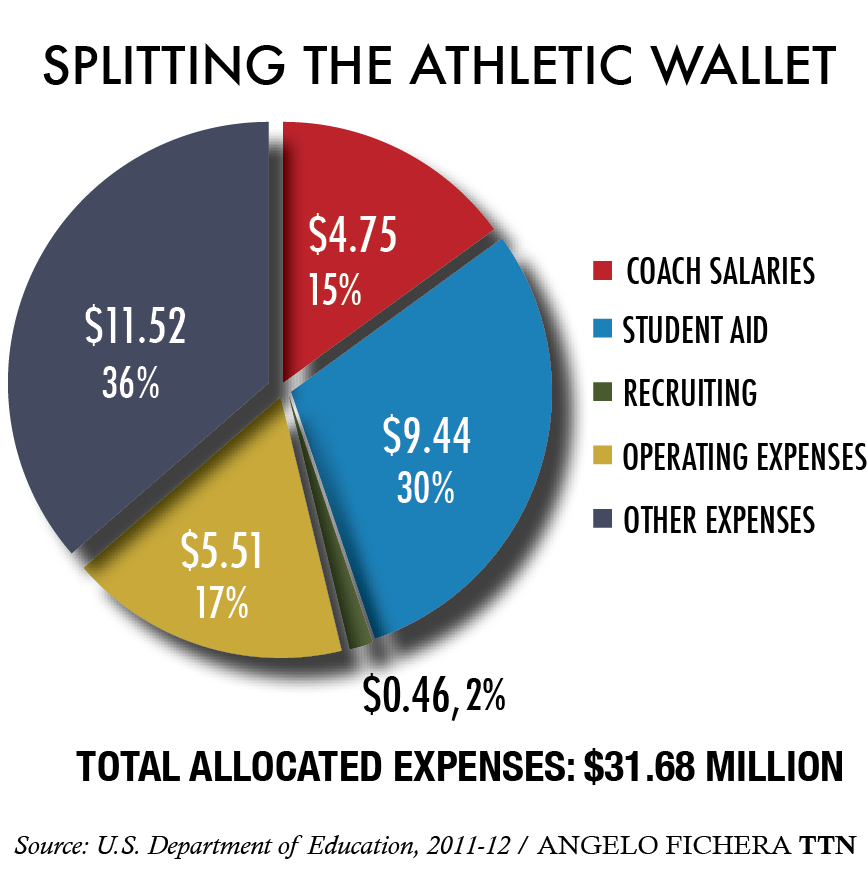
Among all institutions, the largest generated revenue reported was $5.4 million compared to the median at $676,500.1 However, the largest total expense reported was $15.4 million, well above the $6.0 million median.1 The median negative net revenue, which shows a “net loss” for an athletics program, has increased from $2,360,000 in 2004 to $5,172,900 in 2014.1
Image result for ncaa division 2 athletic department budgets
http://temple-news.com/sports/new-look-old-problems/

Typically, the program with the most generated revenue also has the greatest expenses.1 In both men’s and women’s sports, ice hockey has the most generated revenue and most expenses.1 Men’s ice hockey generates $427,700 but has expenses totaling $1,454,800.1 Women’s ice hockey is much lower at $46,900 of generated revenue but $972,900 in expenses.1

The median loss for men’s programs in 2014 was $2,265,200 and that for women’s programs was $1,576,300.1 When it comes to individual sports, the median loss for football programs was $1,098,800, men’s basketball had a loss of $389,900, and women’s basketball slightly less with a loss of $372,800.1

There are substantial differences between public and private institutions. For instance, the median total generated revenue for public institutions is $1,081,700 compared to $393,800 for private institutions.1 Conversely, the total expenses for public institutions on average is $5,682,200 and $7,003,500 for private institutions, the result of a difference of $1,600,000 in grants-in-aid.1

Coaches’ salaries are the highest in ice hockey, football, basketball and baseball for men’s sports.1 Men’s ice hockey coaches have the highest salary at an average of $185,300.1 For women’s sports, ice hockey, basketball, field hockey and gymnastics have the highest coaches’ salaries with ice hockey coaches also receiving the highest salary at $127,200.1 The lowest paid head coaches in Division II athletics are men’s water polo coaches, $6,500, and women’s equestrian coaches, $7,800, when it comes to individual men’s and women’s sports.1

Cash contributions, 41%, and ticket sales, 11%, provide the majority of generated revenue for both public and private institutions.1 However, the two sources combined only provide 8% of total revenue.1 A large majority of total revenue for Division II athletic departments, both private and public, comes from direct institutional support, 64%.1

Grants-in-aid, 34%, and salaries, 30%, make up the majority of overall expenses.1 Grants-in-aid account for 11% of men’s programs expenses and 13% of women’s programs expenses at public institutions.1 At private institutions, grants-in-aid account for more of the total expenses at 18% for men’s programs and 21% for women’s programs.1

The amount of generated revenue and the amount of expenses can differ largely between institutions. Also, the median net loss for an athletic department has seen a significant increase in the last ten years. When comparing public and private institutions, public institutions generate more revenue and have less expenses than private institutions. However, both types of institutions receive the majority of their revenue from direct institutional support and donors.

Reference

1Fulks, D. L. (2015, September). Revenues and Expenses: 2004-2014 NCAA Division II Intercollegiate Athletics Programs Report. Retrieved from http://www.ncaa.org/sites/default/files/2015%20Division%20II%20RE%20report.pdf

Title IX and Athletics

Title IX is part of the Education Amendments of 1972 and is enforced by the Office for Civil Rights.1 The amendment protects people from sex discrimination in educational programs or activities that receive Federal funding from the Department of Education.1 Athletics programs are considered educational programs or activities and must comply with Title IX. The law applies to athletics in the areas of participation, scholarships, and other benefits.2

Image result for title ix
http://www.govst.edu/TitleIX/
For an institution to be in compliance with Title IX, men and women must be provided equitable opportunities to participate in sports, although identical sports do not have to be offered.2 Institutions may provide male and female student-athletes with opportunities for participation that are substantially proportionate to their respective rates of enrollment of full-time undergraduate students.2 Also, for institutions who are not currently in compliance with Title IX, the institution may demonstrate a history and continuing practice of program expansion for the underrepresented sex, or fully and effectively accommodate the interests and abilities of the underrepresented sex.2 Essentially, institutions whose enrollment is largely comprised of females will need to provide more opportunities for females to participate than male students, and vice versa.

Title IX also requires that male and female athletes receive athletic scholarship amounts that are proportional to their athletic participation.2 This does not mean that the same amount of dollars must be awarded to male and female student-athletes, just proportional amounts.2 For example, football and volleyball are basically counterparts when it comes to fall sports but a football roster is much larger than a volleyball roster. Therefore, dollar amounts would not be the same for the two sports due to the difference in roster size.

Image result for title ix
http://greekgab.com/10-things-title-ix-impacts/
Male and female student-athletes must also receive equal treatment in the areas of equipment and supplies, scheduling of games and practice times, travel and daily allowance/per diem, access to tutoring, coaching, locker rooms, practice and competitive facilities, medical and training facilities and services, housing and dining facilities and services, publicity and promotions, support services, and recruitment of student-athletes.2 Equal treatment in these areas again refers to proportionate facilities and services. The football and volleyball comparison can also be used with this regulation as a football player requires more equipment than a volleyball player does.

Compliance with Title IX is assessed through a total program comparison.2 In other words, the entire men's program is compared to the entire women's program, not just one men's team to the women's team in the same sport.2 Males and females can participate in different sports according to their respective interests and abilities.2 Thus, broad variations in the type and number of sports opportunities offered to each gender are permitted.2

Title IX of the Education Amendments of 1972 aims to end sex discrimination in federally funded institutions. The legislation affects athletics by requiring scholarship amounts, participation opportunities, and other benefits to be proportionate to enrollment and athletics participation. This ensures that individual sports are treated fairly and equally. This is also why compliance with Title IX is assessed by comparing entire men’s and women’s programs and not individual sports.

References

1U.S. Department of Education. (2015, April 29). Title IX and Sex Discrimination. Retrieved from http://www2.ed.gov/about/offices/list/ocr/docs/tix_dis.html

2National Collegiate Athletics Association. Title IX Frequently Asked Questions. Retrieved from http://www.ncaa.org/about/resources/inclusion/title-ix-frequently-asked-questions#title

NCAA Division II Violations

Image result for ncaa division ii logo
http://www.ncaa.org/about/resources/media-center/news/division-ii-begins-rollout-make-it-yours-logo
The use of violations ensures that member institutions remain in compliance with NCAA regulations. At the Division II level, there are two types of violations, secondary and major.

A secondary violation is a violation that is isolated or inadvertent in nature and provides, or is intended to provide, only a minimal recruiting, competitive or other advantage.1 Additionally, secondary violations do not include any significant impermissible benefits.1 Impermissible benefits include, but are not limited to, an extra benefit, recruiting inducement, preferential treatment, or financial aid.1 Multiple secondary violations by a member institution may be considered a major violation.1 Major violations include all other violations, excluding secondary violations, and especially those that provide a significant recruiting or competitive advantage.1

Most major violations pertain to extra benefits, responsibilities of the head coach, fulfillment of credit hour requirements, two-year college transfers, and an institution's responsibility to certify academic eligibility.2 Among secondary violations, the most common violations involve permissible expenses provided by the institution for practice and competition, comments prior to signing, tryouts, requirements for official visits, and full-time enrollment requirements for practice or competition.2

All violations, secondary and major, must be reported to the NCAA. Secondary violations can be self-reported online where the member institution proposes its own corrective actions or penalties for committing the violation.3 However, if the NCAA feels that the penalty is not sufficient enough, they will be in contact with the institution to make them aware of the more significant repercussions of the violation. The institution’s respective conference office may also enforce corrective actions or penalties as a result of the violation.3 If the eligibility of a prospective student-athlete or enrolled student-athlete was impacted by the violation, the institution’s compliance staff can request that the student-athlete be reinstated by the NCAA student-athlete reinstatement staff.3

Both secondary and major violations result in penalties, although major violations will present more severe repurcussions. A student-athlete’s eligibility can also be impacted by violations and, therefore, may need to be reinstated by the NCAA staff. The NCAA uses violations to ensure that member institutions remain in compliance with legislation.

References

1National Collegiate Athletic Association. (2016). 2016-17 NCAA Division II Manual. Indianapolis, IN: National Collegiate Athletic Association.
2National Collegiate Athletic Association. (2015, October 29). Most Frequently Violated Rules: Division II Infractions Process. Retrieved from: http://www.ncaa.org/sites/default/files/enforcementhandouts_DIIViolatedRules_20151029.pdf
3NCAA Enforcement Staff. (2015, September). NCAA Member Resource Guide: Investigating and Reporting Bylaw Infractions to the NCAA Enforcement Staff. Retrieved from http://www.ncaa.org/sites/default/files/MemberResourceGuide_Enforcement.pdf